
To credibly quantify the health impacts of climate change, researchers must embrace a blend of data sources, including Earth Observation and multimodal approaches to causal inference.
WHO estimates that between 2030 and 2050, climate change will cause about 250,000 additional deaths per year due to malnutrition, malaria, diarrhoea, and heat stress alone. Climate change affects human health through multiple pathways, including heat stress and air pollution, as well as food insecurity and mental health. Organizations and policymakers are challenged to understand and prioritize potential policy levers and measures to adapt to or mitigate impacts on human well-being.
To develop effective policy, it is crucial to disentangle these pathways and quantify who is affected, by how much, and under which policies. Researchers across the social sciences have developed statistical methods which leverage earth observation (EO) data for causal inference, resulting in a powerful methodology: it identifies natural experiments, instrumental-variable strategies, and quasi-experimental evaluations to isolate the health impacts of temperature shocks, floods, or droughts from confounding trends and uses panel data to study heterogeneity across income groups, genders, or regions. They also bring welfare economics and distributional analysis to bear, translating biophysical impacts into measures such as lost earnings, medical expenditures, and changes in inequality, and placing them within cost–benefit frameworks for adaptation and mitigation. Structural modelling and dynamic econometric models then allow for the simulation of counterfactual climate and policy scenarios. For example, how heat waves change labour supply and health outcomes under different levels of social protection, complementing epidemiological and climate models with behaviourally grounded responses and policy-relevant predictions.
Blending Earth Observation Data with Traditional Surveys to develop policy-relevant predictions
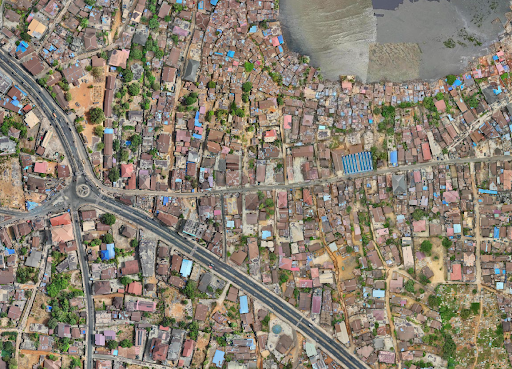
To do this credibly at scale, we increasingly need many kinds of data to “see” climate-health risks that administrative surveys miss. Planetary Causal Inference (PCI), developed by Connor T. Jerzak, is one response: it proposes fusing earth observation data with traditional surveys and causal designs, using satellite images, text, and other multimodal inputs to build proxies for socio-economic conditions and exposures, and then slotting those into experimental and observational causal pipelines. Here is a quick tutorial on how this is done. Work from the AI & Global Development Lab shows, for instance, that multimodal EO+LLM models can predict household wealth across Africa at high resolution, providing a rich covariate and outcome space for poverty and vulnerability research. Researchers can systematically use deep neural networks to extract structure from unstructured images and text, e.g., detecting economic activity or built-environment features in satellite imagery and embedding those predictions into standard econometric analyses. The recipe for using these multimodal approaches with increased computing power and artificial intelligence is starting to look like this: combine geocoded treatment data, deep learning on high-resolution imagery, and econometric designs to construct remotely sensed outcomes (such as housing quality) and estimate treatment effects when conventional survey follow-up is infeasible. Together, this ecosystem comprising PCI, deep learning for economists, and EO-based evaluation broadens the scale and dimensionality of the data economists can use to study climate and health.
Satellite-derived information about roofs to model human heat exposure.
When it comes to human heat exposure, one particularly promising but still underused application is satellite-derived information about roofs. Economists have already treated roof material and quality as a summary measure of housing quality and wealth for example in Marx et al.’s work on ethnic patronage in Kenyan slums and Michaels et al.’s slum-upgrading study in Tanzania, which code roofing materials and structure to proxy long-run improvements in living standards, and in Huang et al., who use deep learning on high-resolution satellite imagery to extract building footprint and roof-type metrics and show that cash transfers increase “tin-roof area” as a remotely sensed measure of improved housing quality. Links to their work are available here, here, and here. Urban climate and planning studies similarly emphasise that roof materials (colour, albedo, insulation, green roofs) and other surface properties are central drivers of the urban heat island effect and local microclimates, with guidance documents stressing how construction materials and surface characteristics mediate heat retention and, ultimately, heat-related health risks.
The UNC Durham project explicitly notes that standard satellite land-surface temperatures capture roof and ground temperatures but miss pedestrian-level heat stress, motivating the combination of rooftop thermal signals with in situ sensors to understand health-relevant exposure.Put together, this suggests a clear (if still nascent) agenda: roof data from satellites, when linked to land-surface temperature, Urban Heat Island (UHI) maps, and health or mortality data could be used as an exposure measure for heat risk. In addition, this could also strengthen analyses on how interventions such as cool roofs, green roofs, or upgrading from low-quality to reflective roofing materials translate into tangible health gains.
What’s next?
There is a need to bridge the gap between advanced data science and policy and program implementation. Methodological and technical translation can help utilize new methodologies in real-world applications through:
1. Training and Capacity Building of analysis and MEL staff.
2. Developing the necessary data infrastructure to fuse disparate data sources.
3. Leading small, high-impact pilot projects demonstrating the value of PCI.
Written by: Balasubramanyam Pattath (Balu), Denise Soesilo
Image: CC-BY-4.0 Ivan Gayton.